Why Your Forehand Has No Power (And How To Fix It For Good)
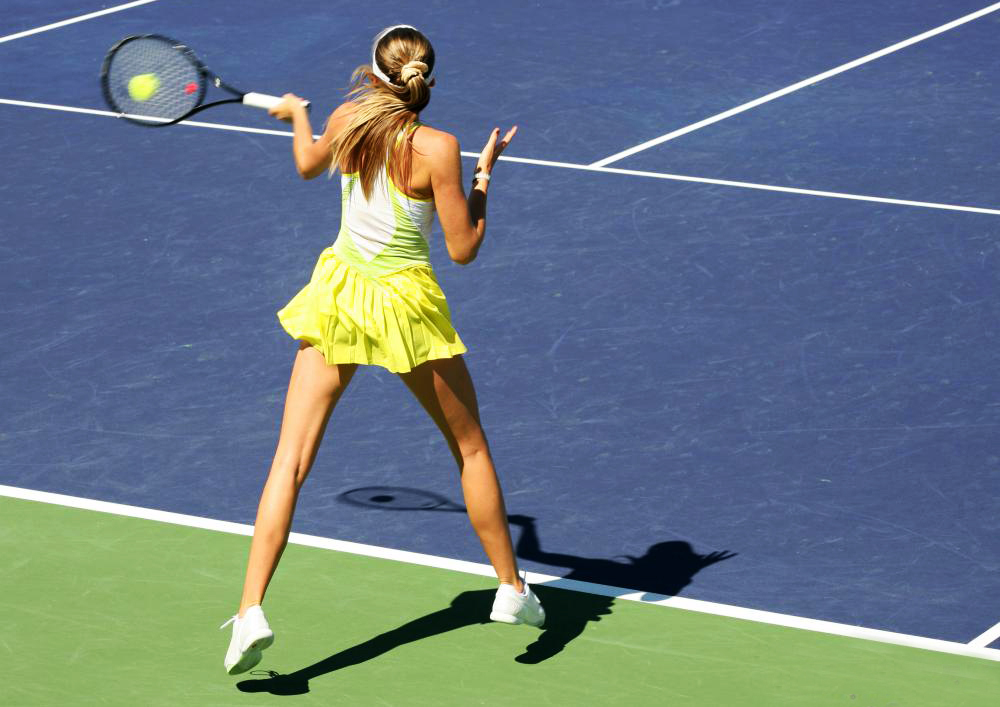
The forehand is the most versatile shot in tennis, yet it’s the one that frustrates recreational players the most. If you’ve ever felt like you’re swinging as hard as you can but the ball floats back like a beach ball, you’re not alone. I’m Nate, a PlayYourCourt Tennis Pro, and after thousands of teaching hours and analyzing thousands of recreational forehands, I can tell you the problem almost never comes down to strength. It comes down to mechanics.
Key Takeaways
Here’s what you need to know before we dig in:
- A weak forehand almost always stems from inefficient body mechanics and poor timing, not lack of muscle. Most players have plenty of strength but waste it by using only their arm to swing.
- You’ll learn specific fixes for your forward swing, how to use body rotation instead of arm muscle, and how to safely unlock more power without spraying balls long.
- This guide walks through setup, unit turn, swing path, contact point, and follow-through, and busts the most common myths (like “just hit the ball harder”).
- I’ve spent 15+ years coaching players from 2.5 to 5.0 through in-person lessons and video coaching with PlayYourCourt, and the same fixable errors show up again and again.
- Throughout this article, you’ll find links to PlayYourCourt YouTube videos and other videos so you can watch each technique in action.
Why You Think Your Forehand Is Weak (Nate’s Diagnosis)
After 15+ years of coaching and over 10,000 teaching hours, here’s what I see 9 out of 10 players get wrong about forehand power: they think they need to swing harder. They assume the problem is a slow racket or a weak arm. But when I film their stroke in slow motion, the real issues jump off the screen: no shoulder turn, late contact, and a broken kinetic chain where the arm is doing all the work.
Here are the four complaints I hear every single week from PlayYourCourt students:
- “My ball always lands shallow, right around the service box.” (Insufficient topspin can lead to Short Court Syndrome.)
- “Fast balls feel impossibly heavy to return.”
- “When I try to swing harder, I spray it long or wide.”
- “My forehand works fine in warmups but falls apart in matches.”
Common causes of a weak forehand include using primarily the arm and poor rotation. Some players develop what I call Forehandophobia-a genuine fear of hitting their forehand under pressure because they don’t trust it.
When students send me video through PlayYourCourt’s coaching platform, the same flaws appear over and over: minimal hip and shoulder coil, contact even with or behind the body, and an arm-only swing that bypasses every power source below the chest.
The rest of this article is your step-by-step rebuild. We’ll fix your stance, your unit turn, your forward swing, your contact, and your follow-through, with clear “don’t do this” examples along the way.
The Real Source of Forehand Power: Kinetic Chain, Not Arm Muscle
Power in a forehand comes from the ground up through the kinetic chain. Picture it like this: energy starts in your feet, travels through your legs, into your hips, up through your torso, across your shoulders, down your arm, and finally into the racket head. Each segment accelerates the next. If any link breaks, power leaks out.
This is why swinging primarily with your shoulder and arm limits racket-head speed in a forehand. Your biceps and forearm are relatively small muscles compared to your glutes, quads, and core. Forehand agonist muscles are stronger than antagonist muscles, but using only your arm to swing limits racket-head speed because you’re skipping the biggest force producers in your body.
Research on segment contributions to racket speed breaks down roughly like this:
- Upper arm internal rotation: ~30–35%
- Horizontal flexion of the upper arm: ~20–25%
- Trunk, hip rotation, and leg drive: essential for establishing energy and enabling the “whip” in the arm
- Wrist and forearm: ~5–25% depending on shot type and grip
The strongest forehands rely on coordinated weight transfer through the body, not arm force. When you watch players like Nadal or Alcaraz, their massive body rotation and lag create racket speed that no amount of arm muscle could replicate alone.
My coaching cue: “If your legs and hips stop, your forehand stops. Your arm is just the messenger, not the engine.”
Stance and Setup: You Can’t Hit Big If You Start Wrong
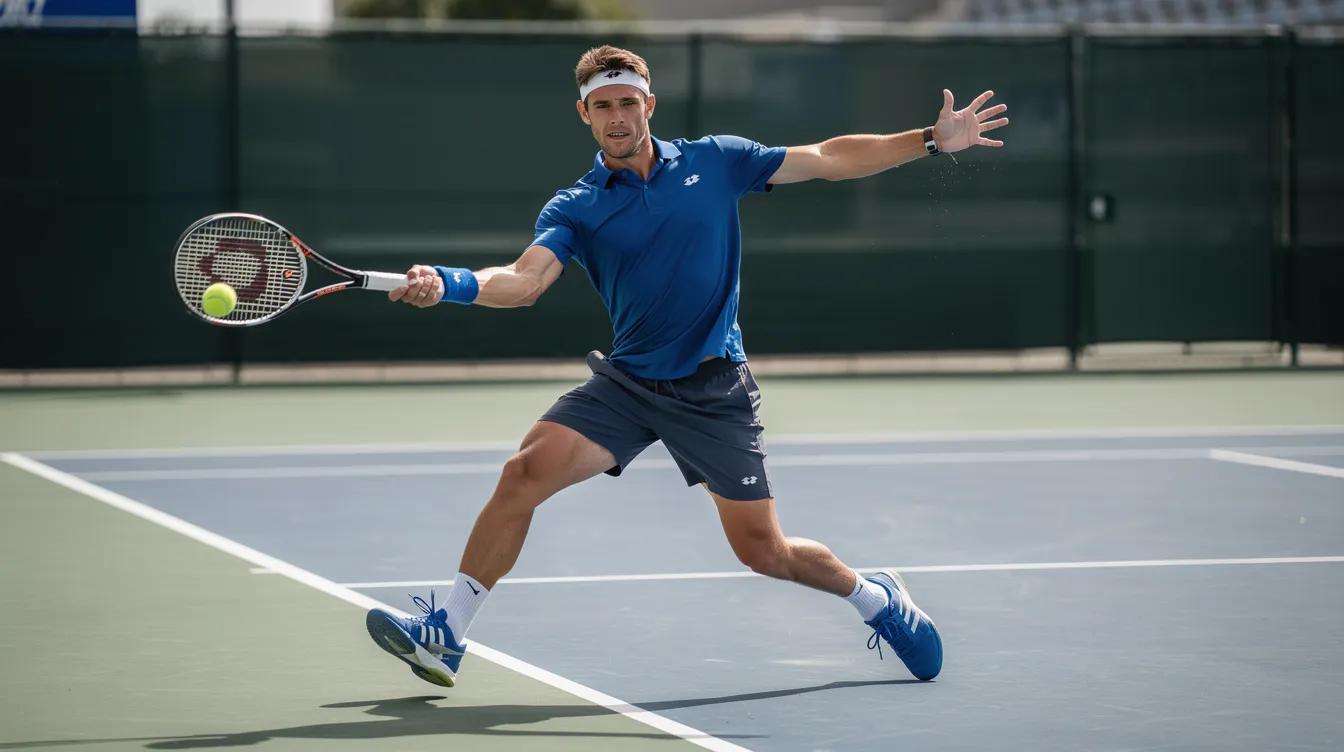
Most rec players I see stand tall, square to the net, flat-footed. From that position, it’s physically impossible to drive body weight into the ball. Poor footwork prevents making a full relaxed swing, and falling backward limits the power you can generate with your forehand.
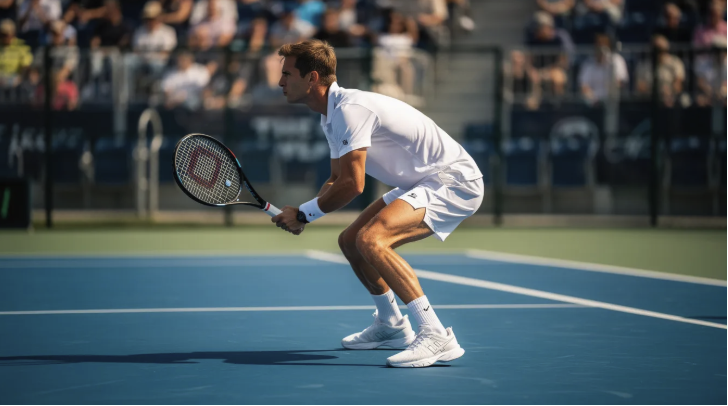
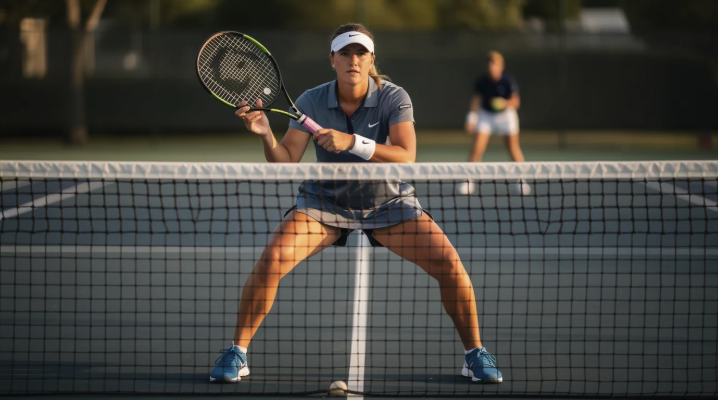
Here’s what your ready position should look like:
- Knees slightly bent, weight on the balls of your feet
- Non-dominant hand resting on the throat of the racquet
- Chest facing the net, eyes tracking the incoming ball
- Feet roughly shoulder-width apart for balance
On modern hard courts, semi-open and open stances dominate because they allow you to rotate your hips and torso freely while still transferring weight forward. Neutral stances work well when you have time, but the open stance lets you load your outside leg and drive into the shot even when stretched wide.
Setup checkpoints I give students: “nose behind the ball,” “inside foot loaded,” and “butt of the racket pointing roughly at the incoming ball.” These cues help you find the right position before your swing even starts.
Arriving off-balance reduces the stability needed for power in a forehand. Common mistakes I see include feet too close together, leaning backwards, stepping across too early, and drifting sideways instead of forward into the court.
For a deeper look at footwork fundamentals, watch our breakdown of tennis footwork drills and techniques.
Unit Turn and Shoulder Coil: The “Free” Power Most Players Never Use
The unit turn is the single biggest piece of “free” power most recreational players leave on the table. It means rotating your shoulders and hips together as soon as you recognize the forehand, instead of just pulling the racket back with your arm.
Lack of rotation results in reduced power in the forehand. Players who face the net too long and rush their backswing end up arming the ball with zero torso contribution.
Here’s how to execute a correct unit turn, step by step:
- Split step as your opponent makes contact.
- Pivot with your outside foot, turning your hips.
- Rotate your shoulders so your non-dominant hand points roughly toward the incoming ball. Utilizing the non-dominant hand can aid in shoulder rotation during the takeback.
- Keep the racket head above your hands, strings roughly facing the side fence, not the net.
Think of it like winding a spring. The unit turn stores elastic energy in your core and hip muscles, which later releases as racket speed during the forward swing.
Common mistakes:
- Yanking the racket immediately behind the body (too much backswing, not enough turn)
- Shoulders barely rotating while the arm does all the work
- Opening up the torso too early before the arm catches up
- Taking the racket back too high and too far, creating a long, slow loop
A simple drill I run with adult beginners and 3.0–4.0 players: stand at the baseline and do 10–15 shadow swings focusing only on the early unit turn. No ball. Just feel the coil and uncoil. This builds muscle memory fast.
Forward Swing Mechanics: How to Actually Create Racket Speed
This is the core section. If you fix nothing else, fix your forward swing.
Initiating the swing with hips and torso rotation leads to more power. Here’s the sequence:
- Your legs drive up and into the ball, pushing off the ground.
- Your hips start to rotate toward the net.
- Your torso follows, slightly lagging behind the hips.
- Your shoulder, arm, and racket lag even further behind-this is the “lag” position.
- The racket drops below the ball as the butt cap leads toward the contact zone.
- The racket head accelerates up and through contact, creating forward acceleration and topspin.
The lag position is where the magic happens. When the butt cap leads and the racket head trails behind your hand, you’re loading the stretch-shortening cycle, essentially storing elastic energy that converts into explosive racket speed. A loose grip can help with power potential by allowing wrist lag, while gripping the racket too tightly reduces the whip effect needed for racket speed.
A modern topspin forehand requires a low-to-high racket motion. Your swing path should travel along the intended line of flight, brushing up on the ball to produce topspin while still driving through it. Topspin requires a low-to-high swing for effective execution. Forehand topspin is generated by the stronger agonist muscles working through this path.
If your forward swing starts only from the elbow or shoulder, you’ll never access the body weight your legs generated. That’s why using only your arm to swing limits racket-head speed.
Common faults to watch for:
- A swing that is too steep creates topspin but lacks penetration-swinging too vertically reduces forward drive and overall power
- A straight-armed push with no lag (no racket drop)
- Stopping the swing at contact instead of accelerating through
- Pulling across too early trying to add spin without any forward drive
- A low backswing can result in hitting long balls if there’s no upward brush to create shape
For a visual demonstration, check out how this technique can add 15mph to your forehand.
Contact Point and Racket Face: Where Power Is Won or Lost
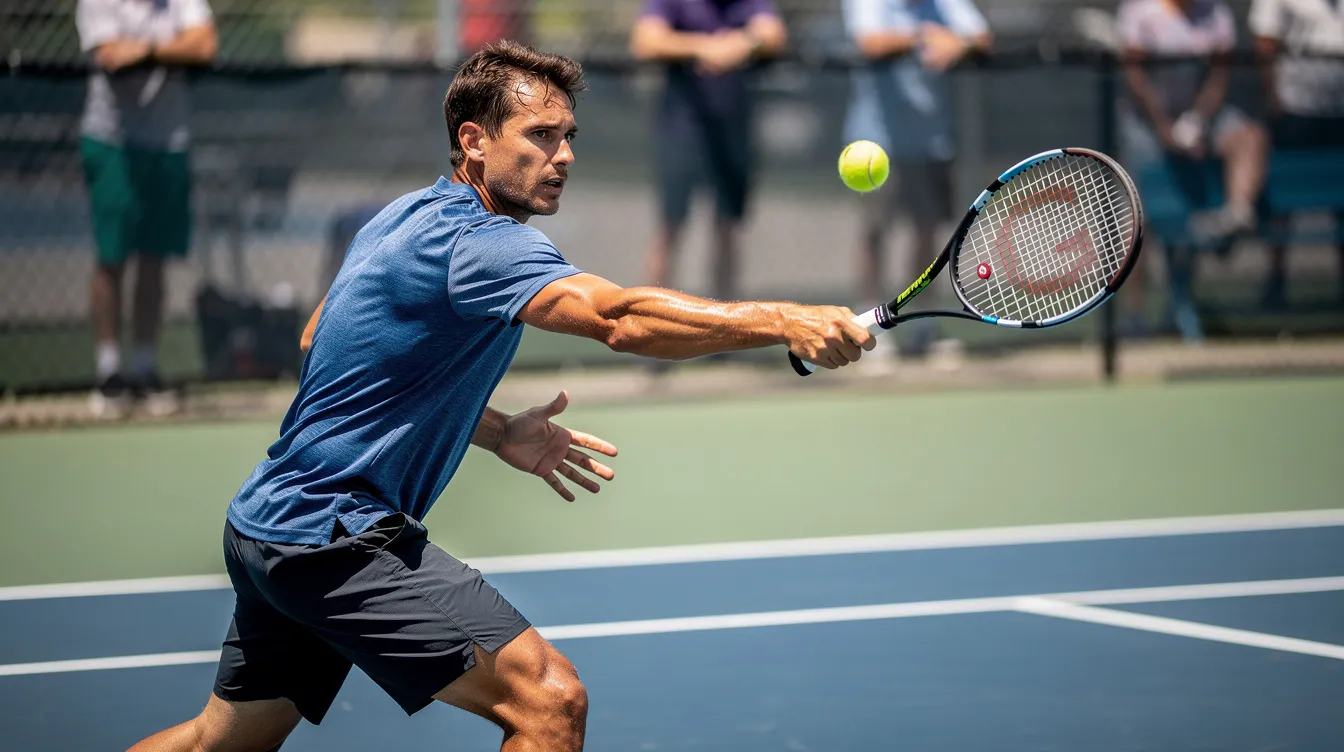
Even perfect preparation won’t create power if contact is late, too close to the body, or with a misaligned racket face. Hitting the ball in front of your body engages the full kinetic chain for power. Poor timing while hitting causes ineffective weight transfer and power generation.
Here’s what optimal contact looks like:
- Slightly in front of the front hip
- At about waist to chest height, depending on the incoming ball
- Arm comfortably extended but not locked straight
- Maintaining proper spacing is critical to achieving an effective forehand-standing too close to the ball prevents full extension and reduces leverage
For racket face orientation: slightly closed for heavy topspin, more square for flatter drives, always matching the intended trajectory. Driving through the ball can lead to directional control problems if the face is too open or the wrist is unstable.
Keep your head still and your eyes near the contact zone. Don’t pull your head up early to watch where the shot goes. That fraction of a second of patience makes a huge difference.
Typical rec-player mistakes at contact:
- Hitting even with or behind the body
- Letting the ball crowd them (no room for extension)
- “Picking up” the ball with an open face, creating a pop-fly effect
- Scooping instead of brushing through clean contact
Poor contact wastes racket speed. Off-center hits-toward the frame or tip-reduce energy transfer and give the feeling of “no power” even on a fast swing.
A drill I use constantly: feed yourself slow balls (or use a ball machine at medium speed) and freeze for a split second after contact. Check: is your arm extended? Is the racket face pointing where you wanted the ball to go? Is the ball in front of your hip? This simple freeze drill builds awareness fast.
As Roger Federer once put it: “The most important thing is to make contact in front. Everything else follows from there.”
Follow-Through and Recovery: Finishing the Shot So Power Can Flow
A complete follow-through ensures energy travels through the ball effectively. Yet many players sabotage their own power by decelerating before contact or “braking” the racket right after impact out of fear of missing.
Here’s what a full, relaxed follow-through looks like:
- The racket finishes over or around the non-dominant shoulder
- Your body rotates through the shot naturally
- Your back foot may pivot or come around for balance
- The motion feels smooth, not forced
Different follow-throughs create different outcomes. A high windshield-wiper finish generates more topspin and height. A wrap-around finish drives through the court with more depth. A more linear finish keeps the ball flatter. But all of them require acceleration through contact-not a sudden stop.
Smooth deceleration also protects your elbow and shoulder. A jerky, forced stop puts stress on joints that can lead to injury over time.
Common don’ts:
- Stopping at contact (the “jab”)
- Collapsing the wrist on impact
- Leaning away from the court instead of finishing forward into it
- Cutting the follow-through short due to tight muscles or fear
My coaching cue: “Swing like you’re going to hit three balls in a row stacked in front of each other.” That picture encourages you to hit through the contact zone rather than at a single point.
After the follow-through, take small recovery steps to re-center. In match play and flexible leagues where points develop quickly, those adjustment steps get you ready for the next shot. For more detail, see how to improve your forehand with 4 key follow-throughs.
Common Myths That Are Stealing Your Forehand Power
Let me bust the myths I hear on court every week. Leave your comments below if you’ve fallen for any of these.
- Myth 1: “To hit with more power, just swing harder with your arm.” This is the most destructive advice in recreational tennis. Muscling the ball breaks your timing, ruins the kinetic chain, and often decreases actual ball speed. Research shows that high-performance athletes don’t adopt radically different postures-they generate and transmit force more effectively along the kinetic chain, culminating in a faster whipping action. Swinging harder with your arm alone does the opposite.
- Myth 2: “Power means flattening out every forehand.” Extreme topspin is crucial for a successful forehand. Topspin enhances control and power in forehand shots and allows for a higher margin of error over the net. Extreme topspin keeps shots in bounds and prevents net errors. Pros like Nadal hit forehands at 80–90 mph that still drop safely inside the baseline because of 3,000+ RPM topspin. Forehand issues can stem from insufficient topspin production-not from too much of it.
- Myth 3: “You need to bulk up in the gym before you can hit big.” Most 3.0–4.0 players aren’t anywhere near their technique ceiling. Diego Schwartzman, listed at 5’7″, generates tour-level forehand pace through efficient mechanics. Your lower body and core already have enough force-you just need to use them.
- Myth 4: “Keep the wrist locked and stiff for control.” A tense grip on the racket slows down the swing and reduces power. What you want is a relaxed, stable wrist with controlled lag-not a rigid death grip. The difference between fine control and stiffness is night and day.
Here’s a stat that tells the story: recreational forehands average roughly 47–54 mph, while ATP pros average about 75.1 mph. That gap isn’t about gym time-it’s about technique.
“Every myth I hear on court boils down to trying to control the ball with the wrong part of your body at the wrong time.”
What Pros Do Differently: Forehand Speed, Spin, and Body Use
The speed gap between recreational and professional forehands is staggering. Typical rec forehand speeds land between 47–55 mph. ATP tour forehands average 75.1 mph with spin rates around 2,713 RPM. Stars like Jiri Lehecka average 79.2 mph with 2,992 RPM, and Grigor Dimitrov has been measured at over 80 mph on multiple surfaces.
For historical context, Pancho Gonzales recorded a forehand drive at 112.88 mph back in 1951-proof that raw speed potential has existed for decades.
On the WTA side, Iga Świątek averages approximately 73 mph on her forehands at major events, which overlaps with many male recreational player ranges. She does this at 5’9″ through mechanics, not brute strength.
How do pros create this speed?
- Extreme but controlled shoulder turn and hip rotation
- Deep racket drop that creates pronounced lag
- Exceptional timing of the forward swing sequence
- Topspin rates often exceeding 3,000 RPM, allowing massive power with heavy margin over the net
Even pros known for flatter hitting still rely on body rotation and efficient racket path rather than arm-only swings. The difference isn’t flexibility or fitness-it’s coordination and sequencing.
Rec players don’t need pro-level athleticism to copy core concepts: good unit turn, contact in front, consistent swing path, and relaxed forward acceleration. I often use side-by-side video comparisons in PlayYourCourt lessons, showing a student’s forehand next to a pro clip. The “aha” moment when they see the difference in shoulder coil is worth a hundred verbal explanations. To see this in action, watch how to hit the Nadal forehand.
Drills Nate Uses to Build Real Forehand Power (Step-by-Step)
Here are the drills I run with PlayYourCourt students on local courts. Each one targets a specific piece of the power puzzle.
Drill 1: Shadow Swing for Unit Turn Stand at the baseline with your racket. Perform 10–15 shadow swings focusing only on early shoulder turn and full follow-through. No ball. Cue: “Turn until your chin touches your front shoulder.” This builds the coil-to-uncoil motion into muscle memory before you add a ball.
Drill 2: Drop-Hit Power Progression Hold the ball at waist height, drop it, and hit forehands aiming for deep targets just inside the baseline. Focus on using body weight and a semi-open stance rather than arm muscle. Cue: “Push the ground away with your back foot.” Start with 10 balls, aiming for 7 out of 10 landing past the service line.
Drill 3: “Lag and Snap” Rally Have a partner or ball machine send medium-paced balls. Pause briefly in the lag position before swinging through to feel the racket head trailing behind your hand. Cue: “Feel the butt cap point at the ball before you let the racket go.” This drill teaches you to trust the whip instead of forcing the swing with your arm.
Drill 4: Cross-Court Forehand with Height Goal Rally cross-court, aiming 3–4 feet over the net strap with heavy topspin. This teaches you that more spin can safely support more power. You’ll be amazed at how much harder you can swing when the ball has enough practice clearing the net with margin.
Drill 5: Inside-Out Forehand Footwork Pattern Move around your backhand side, load your outside leg, and drive body weight into the forehand while recovering back to the middle. Cue: “Hear your feet before every shot.” This builds the connection between footwork and force. For a detailed walkthrough, see how to hit an inside-out forehand.
For even more structured drill progressions, explore our tennis drills for intermediate players.
How PlayYourCourt Coaching Fixes Powerless Forehands Faster
From my perspective, the biggest advantage of working with a coach-whether in person or through video-is that we can spot issues in seconds that players miss for years. You can watch other videos and read articles all day, but nothing replaces a trained eye looking at your specific forehand stroke.
Here’s what a typical first forehand power lesson looks like through PlayYourCourt:
- I film a few rally balls from the side and behind.
- We slow it down frame by frame.
- I diagnose stance, swing path, and contact point in real time.
- We pick one or two fixes-never ten at once-and drill them with enough practice reps to groove the new motion.
The slow-motion phone video that students send through the platform creates constant “aha” moments. A 4.0 player will swear their shoulder turn is fine until they see the footage. That visual feedback loop accelerates learning faster than anything else I’ve found.
PlayYourCourt’s flexible model-local coaches on public courts, adult and youth tennis options, practice partners, and leagues-keeps players hitting enough balls per week to actually build new habits. Membership perks like access to our Forehand Mastery Free Video Course, tennis clinics, and gear discounts support a full improvement plan beyond a single lesson.
One quick success story: a 3.0 adult player came to me lacking power on every forehand. We focused exclusively on body rotation and contact point for six weeks. By the end, his forehand speed had increased by roughly 12 mph, confirmed by radar readings. He didn’t change his racket, his strings, or his gym routine. He changed his technique.
If you’re ready for that kind of personalized feedback, book a private tennis lesson and let’s figure out exactly what’s holding your game back.
FAQs: Forehand Power Questions Nate Answers Every Week
These questions come from Google’s “People Also Ask” and from real PlayYourCourt students. If something wasn’t fully covered above, you’ll find it here.
How do I increase my forehand power without losing control?
Prioritize clean contact, heavy topspin, and a consistent swing path before cranking up speed. I have players start on the mini-court, rally with feel and spin, then gradually move back to the baseline. Track depth first, then speed-aim for every ball landing past the service line before worrying about pace. Use targets like cones placed deep in the court. Focus on hitting high over the net with shape. More spin lets you swing faster safely because topspin allows for a higher margin of error, keeping the ball in even when you increase racket speed.
What grip is best for a powerful forehand?
Your main options are Eastern (easy flattening, moderate spin), Semi-Western (modern topspin and power), and Western (extreme spin but advanced timing). A study of 100 volunteers found that players using an Eastern grip generated more static force regardless of contact point. However, Semi-Western is the most common grip on tour and what I recommend for adult rec players who want both more power and heavy topspin on modern hard courts. Avoid changing your grip mid-rally. Find one primary grip and commit to mastering it. For more on grip adjustments, check out Open The Hand For A Better Forehand.
Can I still hit a powerful forehand if I’m not very strong or I’m older?
Absolutely. Efficient mechanics and using body weight and rotation matter far more than raw strength. Many seniors I coach gain significant power simply by improving timing and technique. Adjustments for older players include slightly longer preparation time, focusing on balance and smooth forward acceleration, and avoiding jerky, forced swings. Appropriate racket weight, head size, and string tension can also help. A PlayYourCourt coach can advise on gear choice tailored to your needs through adult tennis lessons.
Does my racket or string setup affect my forehand power?
Frame stiffness, head size, and string tension all influence power. Lower tensions (50–55 lbs) generally give more free power, while higher tensions offer more control. A larger head size provides a bigger sweet spot for cleaner contact. That said, equipment might add a few mph at best. Technique remains the primary driver. I always fix mechanics first, then fine-tune gear. Adjust only one variable at a time so you can feel the difference clearly.
How long does it take to add noticeable power to my forehand?
With 2–3 focused hitting sessions per week and some video feedback, many players see clear gains in 4–6 weeks. More pronounced changes typically develop over 3–6 months as the new motion becomes automatic. Consistency matters more than intensity-lots of quality reps with correct forward swing mechanics beat occasional marathon sessions with bad habits. Structured programs through PlayYourCourt, combining lessons, practice partners, and league play, help you stay on track and measure progress over time.
Keep Improving